
Latest

The Beautiful Napoleon

What a wonderful pastry! Traditionally made with alternating layers of puff pastry (mille-feuille) and pastry cream, then decorated with a shiny poured fondant and chocolate drizzle pattern of varying designs, it is elegant, delicious, and graphically beautiful.

I read through many online recipes, as well as my stand by Pastry book: The Pie and Pastry Bible by Rose Levy Beranbaum, to gather the construction details I needed to create this quintessential pastry in The Cardboard Kitchen. I also looked through hundreds of photo’s from my talented Flickr friends. I used my Flickr friend Jen’s Photography food set as the resource for my primary image reference. Her Chocolate Napoleon not only gave me the graphic line quality I was looking for, it is also up close and personal luscious!

I had to ’shop’ for four key ingredients: puff pastry; pastry cream and white poured fondant. Fortunately  I had  a small amount of chocolate glaze in The Cardboard Kitchen pantry from another baking project.

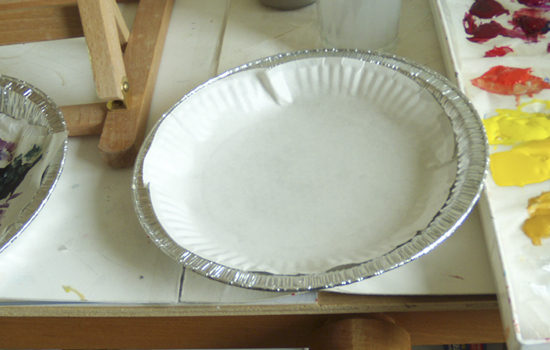
I began with  my hunt for the pastry, and found the perfect mille-feuille in a furniture store recyling bin. I think you will agree that, although it may not have “a thousand leaves”, after a little kneading  and folding, it looks like flaky layers of puff pastry!

The most difficult ingredient to find was the pastry cream. It had to be the perfect color and just the right texture to create the slight ooze between the layers of mille-feuille.

The  shiny poured fondant was created from a shipping box which once held wire shelving. The ink used to print on the background layer of this box provided just the right sheen.

The traditional chevron pattern is created by piping the chocolate glaze onto the white glaze  and pulling it through before the glazes are set up. Using this technique, the piped chocolate appears to be raised ever so slightly above the shiny poured fondant. In art we call this a bas-relief!

Of course there is no way to pull chocolate cardboard through white cardboard fondant, so to achieve this bas-relief feel, I inlaid it. No need to mention how many times I had to do this over to achieve the perfect glazed top, let me just say YIKES….

The  pièce de résistance  was my find of a discarded and torn section of architectural board: the type used by architects to make their fantastic models. It made the perfect pastry wrapper to prevent sticky fingers.

Although you can’t eat it, I think you’ll agree the Napoleon baked in The Cardboard Kitchen is visually delicious!

Posted by admin on Jan 2nd 2010 | Filed in The Cardboard Kitchen | Comments (0)

Artist

ProfileArt On The Menu is the test kitchen of a foodie artist. From the humble to the haute, cardboard to paint, I never read a recipe without a brush or glue in my hand.

My recipe card says food is beautiful! It’s a full course meal of taste, color, shape, and texture. And that’s what I’m serving up here through painting, constructing, baking and cooking!

Bon Appetit!

more...

The Lucious Last Local Tomato

I know I am not the only person eating tomatoes several times a day during tomato season. There is no substitute for the flavor of a tomato in season. And in the Pacific Northwest, tomato season can last into late Fall because our summers don’t really begin until late July.

This is a delicious trick of Mother Nature.  In the Fall, when those who eat tomatoes out of season are buying bland substitutes from across the globe, we continue to get the very best intensely flavored vine ripened varieties of tomatoes.

The added benefit from an artistic point of view, are the brilliant  reds, greens, oranges and yellows among the muted colors of the Fall veggies. And as if that wasn’t enough, the abundance is amazing:  Mother Nature stores extra energy so she can offer up as many tomatoes as possible before the tomato bar closes for the season! I particularly look forward to buying extremely reasonable flats of big misshapen and colorful Heirlooms  late September thru late October. I quarter, roast, and freeze these for use all winter, but that’s another post!

At the end of the season when the flavors peak they may not look their best, so I transform them into into a beautiful and delicious tart which uses the equally abundant zucchini. I found this recipe in the New York Times about 15 years ago. It is called “Connie’s Tomato Zucchini Pie” although I have long since lost any reference as to who Connie may be. I think she will forgive me.

This is originally a pie recipe, but somewhere in the distant tomato past I began making it as a tart. I love the flaky buttery taste of the tart crust layered with the other flavors, as well as the way it looks! If using a tart crust it should be blind baked. The pie shell version calls for an unbaked crust.

Either way, tart or pie,  I think you will agree it’s a Grande Finale for the last tomatoes of the season!

Connie’s Tomato Zucchini Pie (if using pie shell, amounts in parentheses)

1   9 1/2-10″ blind baked tart shell* or unbaked pie shell
1/2 cup Dijon mustard (1/3)
3/4 lb. mozzarella thinly sliced (1 lb.)
4 medium firm ripe tomatoes (5)
2 medium zucchini thinly sliced (2 large)
1/2 teaspoon chopped garlic divided, or to taste-I use 3 cloves!
1/2 teaspoon dried oregano, or 1 tsp fresh finely chopped or to taste divided
2 tablespoons fresh chopped basil, or 1 tablespoon dried, divided (if using fresh basil only chop 1   tablespoon at a time to prevent browning)
Salt and Freshly ground pepper to taste
1 1/2 tablespoons extra virgin olive oil (2 tablespoons)

• Preheat oven to 400° with a baking sheet.

• Spread mustard evenly over the bottom of the shell.

• Cover completely with mozzarella.

• Sprinkle 1/2 of the garlic, oregano and basil on top of the cheese.

• Beginning at the outer edge of the shell, make layered overlapping rows of tomato and zucchini slices,  alternating for color.

• Sprinkle the top evenly with the remaining garlic, oregano, and dried basil.  If using fresh basil sprinkle the remaining on before serving.

• Season to taste with salt and pepper, and sprinkle with extra virgin olive oil.

• Put the tart on the baking sheet (for a tart  I recommend using pie shields for the first 20 minutes) and bake 30 min. (For the pie version bake 40 min.)

If using fresh basil, cool before serving and sprinkle with remaining basil finely chopped.

*I use Rose Levy Beranbaum’s “Basic Flaky Pie Crust” from the Pie and Pastry Bible. I love this crust!

Posted by admin on Oct 22nd 2009 | Filed in Edible Inspirations | Comments (7)

The Match Made In Heaven

There are those flavors that just work together naturally. Peanut butter and chocolate is one of these perfect pairings. I love the colors as well as the flavors. How classically beautiful is a caramel color paired with a deep, dark brown. On the artist’s palette this translates as raw sienna and burnt umber. When I squeeze these two colors onto my palette, it looks just like chocolate and caramel sauce!

When the style magazine Jalouse asked for a favorite cupcake recipe to accompany my interview, this was my choice: a gooey, chocolate-y comfort food cupcake!

More dense  peanut butter brownie than cake, and topped with a  large dollop of peanut butter flavored buttercream and a chocolate cherry, it’s a perfectly sweet way to pair these two favorite flavors and colors. And don’t be tempted to overlook those chocolate dipped cherries. You may want to make extras. I do.  This gives me an excuse to  eat the ones that aren’t perfect! I love this fun recipe so much, I created the recipe again,  in The Cardboard Kitchen!

Peanut Butter Brownie Cupcakes

Makes 16

For the cupcakes:

1/4 cup unsalted butter 1 package semisweet chocolate chips
1/2 cup peanut butter
1/4 tsp salt
3 eggs
1 tsp vanilla
1 1/2 cup sugar
1 1/4 cups all purpose flour
1/2 tsp baking powder

Preheat oven to 350°

Line muffin tins with baking cups.

In medium bowl, blend sugar, flour and baking powder gently with a whisk until blended. Set aside

Melt butter and chocolate chips in a 2 quart saucepan over low heat, stirring frequently.

Remove from heat and stir in peanut butter until well incorporated.

Beat eggs  into chocolate mixture one at a time until smooth, using a spoon.

Stir in vanilla.

Beat in sugar/flour mix until smooth. Dough will be stiff.

Divide batter into cups, filling 3/4.

Bake 25 to 30 min, or until the tops appear dry. A toothpick inserted will still have a few crumbs sticking to it. The brownies will set as they cool. Spread or Pipe Peanut butter buttercream. Top with chocolate dipped cherry.

Peanut Butter Buttercream

1/4 cups unsalted butter
1/2 cup creamy peanut butter
1 1/2 cups confectioners sugar sifted
1/2 tsp salt
1/2 tsp vanilla
cream or milk to desired consistency.

Beat all ingredients in a medium bowl with electric mixer on medium speed until smooth.

If piping the buttercream, double the above recipe for 16 cupcakes.

Chocolate Dipped Cherries

12 cherries in syrup
12 oz dark chocolate
1 tablespoon butter
Remove cherries from syrup and pat dry.

Melt butter and chocolate in a double boiler over low heat, stirring until smooth and to prevent sticking.

Dip cherry and place on parchment to set.

Place  cherry on top!

Posted by admin on Sep 25th 2009 | Filed in Edible Inspirations | Comments (5)

The Cardboard Kitchen Is Haute Cuisine!

The Cardboard Kitchen was featured in the April issue of Jalouse, the French style magazine!

Many thanks to my friend Otilia for providing the translation, and to Florence Valencourt for the virtual interview. Next time I would like to be interviewed while sipping café au lait along the Champs-Elysées!

To get the American version of the recipe, and to see the homage from the Cardboard Kitchen, be sure to read my next post!

Translation:

CHEF, HERE’S THE RECIPE!

IT’S CARDBOARD CHIC!

Everything that comes out of artist’s Patianne Stevenson’s kitchen is recycled, eco-artsy, and calorie free! A real dream come true for foodies who are concerned about their weight.

“Everything prepared in the Cardboard Kitchen is made from recycled ingredients”, says Patianne Stevenson. “I visit wine stores for boxes with colors, grocery stores for the perfect textures, and art supply stores for that certain thickness. Everyone is very happy to have me remove cardboard boxes, and I love stocking the cardboard pantry! I begin my recipes with an organized work plan. I layout the utensils I will need for each recipe: various sizes of scissors, utility knives, glue brushes, and erasers. I then take a look in The Cardboard Kitchen pantry. I had stored a piece of peanut butter colored cardboard. Mixed with vanilla and chocolate colored cardboard, cut to fit and assembled, I knew this would become a sweet creation. I decided on a cardboard homage to one of my favorite cupcake recipes, Peanut Butter Brownie Cupcake With Peanut Butter Frosting and Chocolate Dipped Cherry. What’s nice about The Cardboard Kitchen is there no waiting until the cupcakes come out of the oven! But sadly, you can’t lick the bowl!

For the gourmands, here is the real recipe:

Makes 12

Cupcakes:

50g butter
100g creamy peanut butter
256g broken chocolate bar
little vanilla extract
3 eggs
175g of flour
200 grams sugar
10g baking powder

Preheat oven to 180C
Melt butter and chocolate in bain marie, stirring to mix
Add peanut butter, blend well
Beat in eggs one at a time, until smooth
Stir in vanilla

In another bowl mix sugar, flour and baking powder.
Add to chocolate mix. Stir until smooth.

Fill muffin cups two thirds full.
Bake 20 min. Cool.

Peanut Butter Cream:

50g butter
100g peanut butter
150g icing sugar
20-30 cl cream

Use a pastry sock to decorate the cupcakes.

Chocolate covered Cherries:

12 cherries in syrup
75g dark chocolate
20g butter
Remove cherries from syrup and pat dry
Melt butter and chocolate in a bain marie
Dip cherry and place on parchment to set.

Place  cherry on top!

Posted by admin on Jun 29th 2009 | Filed in Uncategorized | Comments (2)

Rooting Around In Spring

It actually was in Spring, during my first trip to France, that I discovered the radish sandwich. I couldn’t believe I had lived so long without knowing about this simple, delicious, and incredibly satisfying meal.

Take spicy, salty, sweet, and buttery then place it all in one package! And if that wasn’t enough, you are treated to the crisp snap of radish, and the pleasurable crack of the crust on a fresh baguette. And let’s not forget the little bit of chew from the soft interior.

So, every Spring I wait patiently for the first and sweetest radishes of the season to appear in the Farmers Market. I can then assemble what Susan Loomis refers to in her  French Farmhouse Cookbook as “France’s finest snack”! And indeed it is. A little research told me that this is actually a staple of the provincial kitchen. Although seemingly simple, the flavors layered here are anything but provincial. I would call them sophisticated simplicity.

I have tinkered with it over the years experimenting with the addition of herbs to the butter, and my recipe follows. However in it’s simplest form it is just as delicious with a split baguette, unsalted butter, thinly sliced radishes, and a sprinkling of fleur de sel.

At Art On The Menu we swoon when we bite into this:  sweet herb butter slathered on a crusty baguette, radishes and salt, and all in under 10 minutes! What’s not to love!

Radish Sandwich

Although traditionally made with the delicate bi-colored finger width French radish, I used globe radishes above.

Serves 4 ( or sometimes 1)

1 16″ baguette
1 bunch radishes (approx 12-15 med size radishes)
3/4 cup room temperature unsalted butter
3 tablespoons finely chopped chives
1/2 teaspoon dried tarragon, or 2 teaspoons finely chopped fresh tarragon
fleur de sel, or any fine grained salt

Herb Butter

Combine butter and herbs. Mix well. Can be prepared anytime in advance for the flavors to meld. I sometimes prepare it days in advance. Refrigerate if preparing in advance, and remove to bring to room temp for assembling.

Radishes

Remove greens, and clean radishes well. Thinly slice. You should have approx 2 1/2 to 3 cups  for a 16″ baguette.

To Assemble

Split baguette lengthwise.

Thickly spread herb butter on both sides of the bread. Layer the radishes on, and sprinkle generously with fleur de sel. You will need quite a bit of salt to bring the flavors together. For a 16″ baguette I usually sprinkle 1 to 1 1/2 teaspoons of fleur de sel. Cut diagonally into serving size sandwiches.

Or set out a bowl of fleur de sel and let your guests have fun by salting their sandwiches.

After salting consume immediately: the salt brings out the liquid in the radishes. It all becomes deliciously juicy!

Posted by admin on May 28th 2009 | Filed in Edible Inspirations | Comments (9)

Be-et Ever so Humble

There’s nothing like borscht. It’s simple to prepare, and comforting. And beet season lasts from winter to early spring! And while it’s been a long winter and what seems like an even longer wait for spring as my blog hiatus indicates, some delicious beet-y dishes were served the last three months.

This borscht fest began as a conversation with my friends Otilia and Tudor. I wanted to observe their preparation of my family favorite, which was always just a sweet and savory mix of beets and the kitchen sink.

So one snowy day in the Pacific Northwest I watched the windows steam up as Tudor prepared our borscht,  and Otilia gave me the secrets of borscht in Romania.

In a beet shell Romanian borscht is vegetarian, and “borscht” refers to a starter not unlike the sponge we use in sourdough bread. This imparts a sweet and sour taste.

Is this a soup served at holiday time?

“Yes and no. Borscht is not really a traditional Romanian holiday soup, because it’s a dish that Romanians eat everyday, before the main course. It’s the Romanian equivalent for the French salad, if you will. It’s not festive, and yet, it is indispensable. Also, for Romanians, “Borscht” refers to all kinds of soups, it is not specific to the ones based on beetroots.” Otilia explained that soups become Borscht after adding the secret ingredient: the fermented starter.

What, no recipe?

“The traditional ingredients are: beetroots, onions, carrots, a few potatoes, oil, and “Borscht” (which is a kind of sour soup made from fermented wheat bran that Romanians add to any type of soup, to turn it into “Borscht”). In case you don’t have the “borscht”, you can add some lemon juice at the end, to give it the same sour taste. Beetroot borscht is traditionally eaten with a dollop of sour cream”.

So, the defining magic is in the “borscht”?

“In Romania, borscht designates the base ingredient of any sour soup, called “borscht” or “ciorba”. It’s in fact a sour liquid, made of wheat bran and sour cherry leaves. The sour liquid is added at the end of cooking.”

Otilia then told me you need a start from another “borscht”, to produce your own! She also said that only the grandmothers really know how to make this!

Is Tudor always the soup chef?

“It varies between me and Tudor. If you’re interested, we can do it again for another borscht recipe”.

It was absolutely sweet and delicious!! Write me down for another borscht day in your kitchen,  and thank you both!!

Posted by admin on Apr 28th 2009 | Filed in Talk Of The Table | Comments (0)

The Persimmon Palette

With persimmon’s, it’s about the color!  It ranges right across the oranges, yellows and reds of the cadmium family, and matures with a blush of the earth tones, primarily burnt sienna. Because every flavor has a color in my kitchen, I approach the persimmon through the artist’s palette. The challenge is not only preserving  the delicate and unique flavor of this fruit, it’s preserving the hue and tint as well.

When I taste the silky, soft, intense sweetness of the pulp, I pick up a little spice  and citrus. Since I had an abundance of Hachiya’s to work with, I ignored my usual persimmon recipes which use less pulp, like salsa, and went for the big cheese! I suspended half the pulp in a delicate cheesecake batter which highlights the background flavors. The remaining pulp became a pure glaze of color and flavor.

I found the original recipe on allrecipes.com (attributed to “schmecktqut”), read the comments, and came up with a version which created the perfect persimmon package. I substituted  a ginger snap and walnut crust, added 1 less egg, and drained the pulp through cheese cloth overnight, saving the juice. I also cut back on the spices, using a little dried ginger, and half the nutmeg (fresh).

The glaze took a bit of research, but I finally found the perfect solution: a mirror. This is courtesy of theleftoverqueen. I followed her recipe as printed, with the addition of yellow as well as red (makes orange!) coloring to enhance the color.

And because we don’t want to appear to greedy, I baked them in the small 4″ spring forms. That way everyone can have half a cake without guilt, almost! And you have to admit, the color is a perfect cadmium orange-red!

Posted by admin on Jan 29th 2009 | Filed in Edible Inspirations | Comments (2)

Turn Your Green To Gold!

In spite of the title, this isn’t a post about the economy! It’s a how-to post, dedicated to constructing a really satisfying salad in winter, without those warm climate salad ingredients that we in the northern realms seem to crave.

What brought this on? A discussion with a friend: she lives on salads! We had a great chat exploring how to think outside the salad bar.

One stroll through the farmers market, or vegetable isle in your local supermarket, presents all sorts of wonderful lettuce and tomato substitutes. One of my favorites is squash. Using butternut, pumpkin, or danish, this salad is beautiful as well as delicious. The sweetness of the squash is a scrumptious compliment to the lemon vinaigrette, which also helps to break down the kale or chard ever so slightly. I used fresh squeezed lemon juice from my freezer! And there are a rainbow of substitutions here too, so take your pick.

As a matter of fact, I found coming up with measurements challenging since I usually make this with whatever I have. You can use these amounts as a guideline, or just do your thing to explore the gold.

Now get out your well honed chef knife, cut through that squash, and dice your way to a dish you will look forward to every winter!

Winter Salad With Squash And Kale

(With a nod to my local co-op’s Emerald City Salad, where this all started.)

Serves 6 (or 2!)

2 cups cooked wild rice chilled (make this days ahead!)
6 cups Kale, chard, or a mix (remove stems and chiffonade)
1/2 small fennel bulb very thinly sliced (use your mandeline if you have one)
1/2 cup finely dice red onion
1/2 cup fresh chopped parsley (don’t be tempted to omit this: the brightness adds a great level of flavor)
2 -2 1/2 cups medium diced1 1/ squash (approx 2# butternut whole, 1# danish, or a couple small sugar pumpkins) At times I make this salad with almost all squash and just a a cup of chard/kale, and the parsley for greens. So you could easily reverse the order of squash to greens.
1 tablespoon olive oil
salt to taste

Vinaigrette: or use your favorite vinaigrette, just don’t overdress. The salad should be barely dressed.

1/2 cup olive oil
1/2 cup lemon juice
1-2 teaspoons of minced garlic (to taste)
1-2 teaspoons salt (to taste)
1-2 teaspoons fresh ground black pepper (to taste)

Whisk together the vinaigrette ingredients. Toss with rice to marinate. Set aside

Peel and medium dice the squash. Heat olive oil over medium high in a large saute pan. Saute the squash until just soft and a little crusty. Try not to get the squash too soft. Remove from heat.

Lightly salt to taste. Cool.

Combine  greens, fennel, onion, parsley and squash in a bowl. Chill.

Just before serving toss dressed rice with veggies.

This keeps dressed in the fridge several days, if it lasts that long!

Choose your substitution and/ or addition!

Granny smith apples, barley,  sweet potato, cabbage, cauliflower, chopped nuts, dijon vinaigrette

Posted by admin on Dec 19th 2008 | Filed in Edible Inspirations | Comments (2)

Fall-ing With Apples

In the Pacific Northwest we really do have the very best  local apples.  My inaugural “ode to fall” dish always involves apples. I really look forward to the first Honeycrisps at the farmers market. Sometimes my ode to fall is sweet, but this year it’s savory due to the bumper mushroom crop! Not only were Chantrells incredibly priced, but the Yukon Gold potatoes looked fantastic! Honeycrisps, mushrooms, Yukon Golds: it’s a combination I couldn’t resist.

I love the Honeycrisp because it balances between the tartness of a Granny Smith, and the sweetness of a Fuji with a texture combining both. And, it’s red, with streaks of gold and green! It just perfectly matches the colors of fall and the bite in the air.

My ode to fall recipe comes from Cory Schreiber’s cookbook “Wildwood: Cooking From The Source In The Pacific Northwest”. After making this over the past few years, I have made my own adjustments.  I have added more apple, changed the variety, added mushrooms and occasionally cheese, more thyme, and more potato. What can I say: tinkering is a compulsion!

When I’ve added cheddar or gruyère I mix it into the apple mushroom mix. This addition makes a wonderful  comfort-y dish that is more like a gratin. As is, the Mushroom, Apple, Potato Cake is quite light. And I have to admit: I love it cold the next day for breakfast!

Mushroom, Apple, And Potato Cake

(original recipe amounts given in parentheses)

3 tablespoons olive oil

1 lb mixed mushroom including Creminis, Portobellos, Chantrelles, etc. (cremini/protobello)

1 medium onion finely chopped

2 Honeycrisps or other tart apples (1 Granny Smith)

2 teaspoons chopped fresh thyme (1 tsp)

1 1/2 teaspoon  kosher salt or to taste ( 1 tsp)

3/4 teaspoon fresh ground pepper

1 1/2 - 2 lbs yellow fleshed potatoes such as Yukon Gold (1 lb)

Preheat oven to 450°.

Heat 1 tablespoon olive oil over moderately high heat, in 10 inch well seasoned cast iron skillet, until hot but not smoking.

Sauté mushrooms and half the onion stirring until mushrooms are tender and brown. Transfer to a  medium bowl and wipe out skillet.

Peel and coarsely grate apple, and stir into mushrooms along with thyme, half the salt, and 1/4 tsp  of the pepper.

Peel potatoes, and slice 1/8″ thick (I use my cheapie mandoline). Toss them with remaining onion, salt and pepper.

Fun skillet tricks finish the dish :

Heat remaining olive oil in skillet over moderately high heat.

Add 1/3 of the potato slices in one layer: you will overlap. Top that with 1/2 mushroom mixture spreading evenly. Repeat :potato layer, mushroom layer, and end with potato layer. While you are doing all this, the bottom layer is browning.

Put skillet in the  middle of oven, and bake 20-25 min.

Remove skillet from oven, invert a pizza pan or other round platter over skillet and holding firmly, flip potato cake onto platter. Then slide cake, browned side up, back into skillet and continue baking until underside is crusty and potatoes tender when pierced. This takes about 10.

ps. I have even made this in my stainless steel cookware, and it worked great!

Posted by admin on Nov 21st 2008 | Filed in Edible Inspirations | Comments (0)

Have Your Cake And Felt It Too

In the world of the food obsessed artist it’s not the blank canvas that we have to fill, it’s the empty plate. And look how my friend Heather Laskowski fills hers! Not only is she a talented multi media artist, she’s a bona fide pastry chef as well.

This felted cupcake, with it’s chocolate cake dark enough to satisfy any craving, just crowning over the pink cupcake paper is topped with a meltingly ethereal cloud of white buttercream. And clinging delicately to the buttercream is a scattering of jeweled sprinkles with a big  juicy cherry perfectly balanced on top.

Wait!! Am I confused! Am I describing the felted cupcake or these beautiful Chocolate Cherry Cupcakes  that Heather  baked, decorated, and then posted on her Flickr site?

Life imitates art once again…

If you would like to see more of Heather’s divinely decadent felted sweets you can visit her etsy shop here or her website Merry Moon Designs.

Posted by admin on Nov 7th 2008 | Filed in Edible Inspirations | Comments (0)

Next »